Showing posts with label design. Show all posts

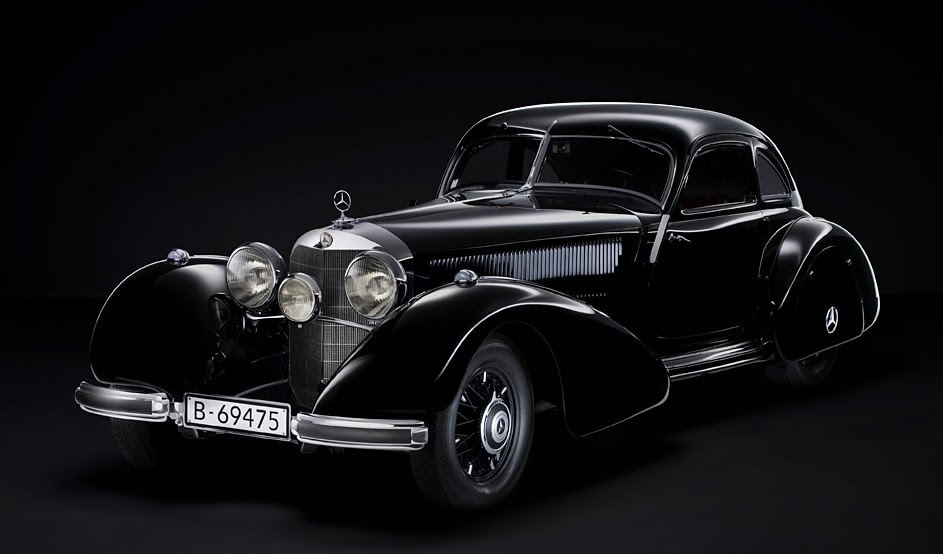
rare and beautiful Benz? The 1934 and 1938 Autobahnkurier


only two were made, the 1934 and the 1938. Yup, 4 years apart and the same model.. but that wasn't uncommon prior to Harley Earl's production changing concept of make the people want to buy a new car every year with constantly changing designs.

the first was gifted to Mohammed Reza Shah of Iran by the German government and spent most of it’s life in Iran, and was found by a Mercedes-Benz truck importer in the 1960s, the car was totally original with only 10,000 km on the odometer.

The second was completed in 1938 for professor Ingacio Barraquer. He was in Germany on vacation from his regular residence in Spain. Barraquer used this car often and went on many long journeys including a famous drive through North Africa. He traveled from Libya, Cairo then finished in Alexandria before the car was shipped back. He found it to be too difficult to maintain and replaced it with a more modern 300S. It was then given to his son-in-law and stayed in the family for decades. For some time it was loaned to Antic Car Club in Catalina who had it displayed in Barcelona.

Eventually, it was sold by the Barraquer family in 2004 (is now owned by Arturo and Deborah Keller) and restored by Paul Russell & Co. before making a debut at the Pebble Beach Concours d’Elegance. It won the award for the most elegant coupe and was a runner up for Best in Show. This was followed up in 2008 by winning the Coppa d’Oro Villa d’Este.

The design is so good, that many claim it inspired Bugatti to design the Type 57
http://www.supercars.net/cars/3604.html

cool images found on americabymotorcycle.tumblr.com


found on http://americabymotorcycle.tumblr.com/ where I was impressed with the amount of the cool things that are posted there

1948 Panhard Levassor Dynavia


found on http://www.cardesign.ru/forum/diskussii/obschenie/1352

1959 Curtiss Wright model 2500


photo from http://www.cardesign.ru/forum/diskussii/obschenie/1352

info from http://www.finkbuilt.com/blog/1960-hovercraft-lineup/
the 1959 Curtiss-Wright model 2500 “Bee”, (AKA “Air-Car”) prototype.

http://www.aerofiles.com/ 
Experimental 2p passenger air-cushion hover-car, built in test form (lower photo), anticipated market in ag application and as swamp buggy; 85hp Continental with 6′ two-blade prop (projected multi-blade props with two 180hp Lycomings) width: 8′0″ length: 28′0″. Michael Cutler et al. Total “flight” time in mid-July 1959 was about 25 hours, albeit only inches AGL; top speed: 35. Displayed at Fort Eustis Transportation Museum, Colonial Williamsburg VA.

C-W experimented in the field of hovercraft with high hopes that the new technology would save their moribund company, and these hopes caused them to issue news releases and drawings of the new product long before the engineering department was ready. I have seen footage of some of the test ‘flights.’ First, the cars looked nothing like the drawing — that sweetheart was a marketing department dream, not reality. What they actually tested was bigger than a Ford Excursion, but still only seated two. It was a big plenum chamber with controllable shutters all along the perimeter for thrust, braking, and control. What the footage shows, however, is that the car was just barely controllable, even over smooth pavement in good weather. The noise was truly awesome, as well. To complete the dismal picture, hover height was only inches, and there was no flexible skirt — it had less off-road capability than an average sedan of the period. It was a wonderful dream, but to have spent millions on it was typical of a management team that took Curtiss from the biggest in the industry to bankruptcy.”

Some cars seem to have emotional features, this one looks mean, like a gremlin from the movie

Think it was accidentally made to look this mean? read about it here http://www.autoblog.com/2009/05/14/veritas-rs-iii-to-officially-debut-at-london-salon-prive/
photo from http://www.cardesign.ru/forum/diskussii/obschenie/1352

the oldest wheels in California, a look at how the first wheels were designed

Above is design, below is what remains of a round piece of wood 205 years after it was installed on an ox cart, consider that the log it was cut from may have been 100 years old to get this big around and it's possible that the wood is over 300 years old.


In the stagecoach museum in Old Town San Diego

Brooks Stevens and the 1959 Scimitar prototypes that promoted aluminum

Two of the different models, the below was the inspriation for the Studebaker Wagonaire

Three Scimitar vehicles were designed and developed to suggest functional and decorative applications for aluminum use in automobiles. The Scimitar project was sponsored by the Olin Matheson Chemical Corporation and was designed by Brook Stevens Associates and Reutter & Company.

A two-door Scimitar convertible was representative boulevard-type sports car, having a hard top that retracted automatically into the luggage area. A four-door Scimitar town car phaeton could be driven as a fully enclosed formal sedan, a town car with partially retracted roof, or an open convertible with both roofs retracted into the luggage area. The Scimitar station wagon shown here has an automatic sliding roof.

All three models were derived from the same basic design and tooling, using a 1959 Chrysler New Yorker chassis. The body utilized removable aluminum anodized quarter panels for aesthetics and reduced maintenance. The grille bumpers, trim, wheel discs, and many interior treatments are of brushed and anodized aluminum, substantially reducing vehicle weight. The car´s name was derived from the shape of a scimitar, a saber with a curved blade.

The three Scimitar models were exhibited first at the 1959 Geneva Auto Show, then at the 1961 International Automobile Show in New York.

Found on http://svammelsurium.blogg.se/ where some really cool stuff shows up

Northrop YB-49 Flying Wing


if you want to learn a bit about flying wing design origin, it goes back to the mid 1930's: http://justacargal-s.blogspot.com/2011/02/burnelli-or-northrop-flying-wing.html

The difference between Mustang engine bays, for a 289 or a Boss 429


Taken from close to the same view angle, these are a terrific aid in determining all the mods that Ford had to do to shove a 427, 428, or 429 into a early Mustang
Thanks to Ed for the photos!